
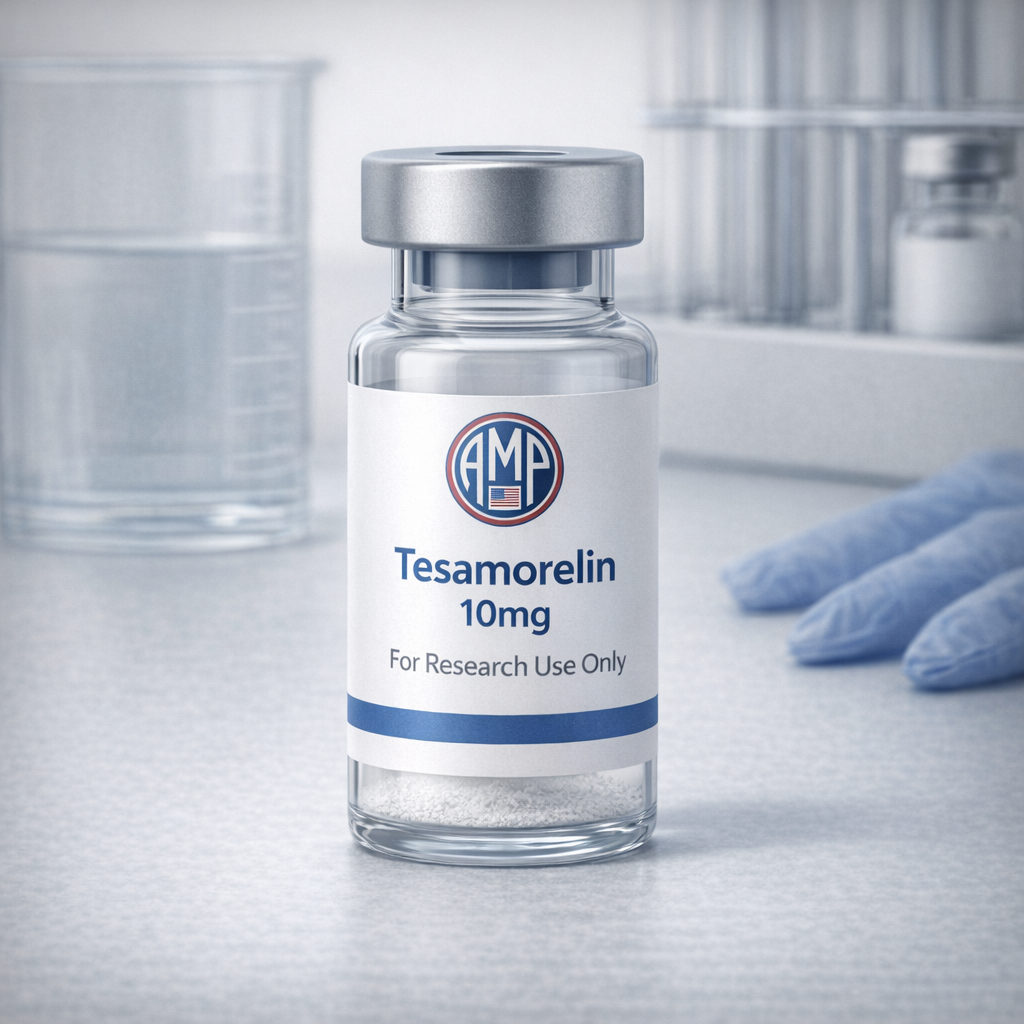
Buy Tesamorelin Peptide – Premium 99% Research Grade Powder
$170.00
Semaglutide research peptide — lyophilized powder, third-party tested, COA-verified. For research purposes only. Not for human consumption.
Description
Buy Tesamorelin peptide for in vitro research from American Made Peptides — the trusted USA source for premium growth hormone-releasing hormone analogue research compounds. We supply Tesamorelin as a lyophilized powder of ≥99% purity, independently verified by third-party HPLC analysis.
Every vial is manufactured in the USA and ships with a Certificate of Analysis confirming peptide identity and purity. For research use only.
Not for human consumption.
Where to Buy Tesamorelin Peptide – Research Overview
Tesamorelin is a synthetic analogue of endogenous human growth hormone-releasing hormone (GHRH) — a 44-amino acid hypothalamic neuropeptide that stimulates pituitary somatotroph cells to synthesize and secrete growth hormone (GH). Tesamorelin consists of the full 44-amino acid sequence of human GHRH(1-44) with a trans-3-hexenoic acid moiety conjugated to the N-terminus, which confers significantly enhanced proteolytic stability against dipeptidyl peptidase IV (DPP-IV) cleavage compared to native GHRH.
Native GHRH is rapidly inactivated in plasma by DPP-IV cleavage between residues Tyr1 and Ala2, yielding a biologically inactive GHRH(3-44) fragment. The N-terminal trans-3-hexenoic acid modification of Tesamorelin sterically blocks this DPP-IV cleavage site, dramatically extending the peptide’s effective half-life and duration of GHRH receptor engagement compared to unmodified GHRH.
Tesamorelin acts as a potent and selective agonist at the GHRH receptor (GHRHR) — a class B Gs-coupled GPCR expressed primarily on anterior pituitary somatotroph cells — activating cAMP/PKA signaling cascades that drive GH gene transcription, GH biosynthesis, and pulsatile GH secretion. Its well-characterized receptor binding and downstream signaling profile makes Tesamorelin a highly valuable research tool for studying the hypothalamic- pituitary somatotropic axis and GHRH receptor pharmacology in preclinical research models.
Research Applications
GHRH Receptor Pharmacology Research
Tesamorelin is a full agonist at the GHRH receptor (GHRHR) — a class B Gs-coupled GPCR that activates adenylyl cyclase, cAMP accumulation, and PKA-mediated signaling cascades in anterior pituitary somatotroph cells. Researchers have used Tesamorelin to study GHRHR binding kinetics, receptor conformational dynamics, cAMP/PKA signaling activation, β-arrestin recruitment, and receptor internalization and desensitization in pituitary and heterologous expression cell models in vitro.
Growth Hormone Secretion Research
Tesamorelin has been studied extensively as a research tool for investigating growth hormone secretion regulation from anterior pituitary somatotroph cells. Research programs have examined GHRHR-mediated GH gene transcription, GH biosynthesis and storage, pulsatile GH exocytosis mechanisms, and the calcium and cAMP signaling requirements for regulated GH secretory vesicle fusion in pituitary cell models.
Researchers have used Tesamorelin in comparative designs alongside other GHRH analogues and GH secretagogues to dissect the distinct signaling contributions of GHRHR versus ghrelin receptor (GHSR) pathways to GH secretion regulation in pituitary cell biology research.
Hypothalamic-Pituitary-Somatotropic Axis Research
The hypothalamic-pituitary-somatotropic (HPS) axis — comprising hypothalamic GHRH and somatostatin neurons, pituitary somatotroph cells, and peripheral IGF-1 production — is a fundamental neuroendocrine regulatory system. Researchers have used Tesamorelin to study
GHRH-driven HPS axis activation, somatostatin counter- regulatory interactions, GH pulse amplitude and frequency regulation, and the negative feedback mechanisms governing somatotropic axis homeostasis in pituitary and hypothalamic cell models.
IGF-1 Axis Research
GH secreted in response to GHRHR activation drives hepatic IGF-1 production — the primary mediator of GH’s anabolic and metabolic effects in peripheral tissues. Researchers have used Tesamorelin to study GHRH-GH-IGF-1 axis dynamics, the hepatic GH receptor signaling cascade driving IGF-1 gene expression, and the temporal relationship between pituitary GH pulse generation and circulating IGF-1 regulation in cell-based and preclinical somatotropic axis research models.
Visceral Adipose Tissue and Lipid Metabolism Research
GHRH-stimulated GH secretion plays a central role in lipolysis regulation and visceral adipose tissue biology. Researchers have used Tesamorelin to study GH-mediated lipolytic signaling in adipocyte cell models, visceral fat cell metabolism regulation, the relationship between somatotropic axis activation and lipid mobilization, and the molecular mechanisms linking GHRH-driven GH secretion to adipose tissue biology in preclinical
metabolic research contexts.
DPP-IV Stability and Peptide Drug Design Research
Tesamorelin’s N-terminal trans-3-hexenoic acid modification provides a well-characterized model for studying DPP-IV protection strategies in peptide drug design research. Researchers have used Tesamorelin alongside native GHRH in comparative studies to investigate DPP-IV cleavage
kinetics, the structural requirements for DPP-IV resistance, and how N-terminal modifications influence GHRH receptor binding affinity and downstream signaling potency in receptor pharmacology research designs.
GHRH Analogue Structure-Activity Research
Tesamorelin is used alongside other GHRH analogues — including Sermorelin (GHRH 1-29), CJC-1295, and modified GHRH fragments — in comparative structure- activity relationship research examining how peptide length, sequence modifications, and half-life extension
strategies influence GHRHR binding affinity, receptor activation potency, downstream cAMP signaling amplitude, and biological activity duration in pituitary cell pharmacology research models.
Neuroprotection and CNS Research
GHRH receptors have been identified in brain regions beyond the pituitary, and GHRH signaling has been studied in the context of neuroprotection and CNS biology. Researchers have used Tesamorelin to investigate GHRHR expression and signaling in hippocampal and cortical neuronal cell models, GHRH-mediated neuroprotective pathway activation, and the potential relationship between somatotropic
axis signaling and cognitive function-related molecular pathways in preclinical CNS research.
View published Tesamorelin and GHRH receptor research on PubMed.
Why Buy Tesamorelin From American Made Peptides?
Researchers who buy Tesamorelin from AMP receive a full third-party COA with every order, confirming ≥99% purity by HPLC chromatography.
USA Manufactured — no overseas sourcing or repackaging.
Third-Party Tested — independently verified by a US-based laboratory.
HPLC Verified — purity confirmed at ≥99% on every batch.
Lyophilized for Stability — powder format ensures maximum shelf life under proper storage conditions.
Learn more on our Lab Testing & COA Hub.
Technical Specifications
| Full Name | Tesamorelin (trans-3-hexenoic acid-GHRH 1-44) |
| Classification | GHRH analogue / GHRHR full agonist |
| Parent Peptide | Human GHRH(1-44) |
| N-Terminal Modification | trans-3-hexenoic acid (DPP-IV protection) |
| Chain Length | 44 amino acids |
| Target | GHRH receptor (GHRHR) — class B Gs-coupled GPCR |
| CAS Number | 218949-48-5 |
| Molecular Weight | ~5135 Da |
| Purity | ≥99% (HPLC verified) |
| Form | Lyophilized powder |
| Appearance | White to off-white powder |
| Storage | -20°C, away from light and moisture |
| Reconstitution | Bacteriostatic water recommended |
| Shelf Life | 24 months lyophilized / 30 days reconstituted at 4°C |
Storage and Handling
Store lyophilized Tesamorelin at -20°C in a dry environment, protected from direct light and humidity.
Once reconstituted with bacteriostatic water, store at 4°C and use within 30 days. Do not refreeze reconstituted peptide.
Certificate of Analysis
When you buy Tesamorelin from American Made Peptides, every batch ships with a downloadable Certificate of Analysis.
The COA confirms identity via mass spectrometry and purity via HPLC. Visit our Lab Testing & COA Hub.
Frequently Asked Questions
Why do researchers buy Tesamorelin for lab studies?
Researchers buy Tesamorelin to study GHRH receptor pharmacology, growth hormone secretion regulation, hypothalamic-pituitary- somatotropic axis biology, IGF-1 axis dynamics, visceral adipose tissue and lipid metabolism signaling, DPP-IV resistance peptide design strategies, GHRH analogue structure-activity relationships, and CNS GHRHR signaling. Its full 44-amino acid GHRH sequence combined with enhanced DPP-IV resistance makes it the most complete and stable GHRHR agonist research tool available for studying the full scope of GHRH receptor biology in pituitary and metabolic research programs.
What is the difference between Tesamorelin and Sermorelin?
Sermorelin is a synthetic analogue of GHRH comprising only the first 29 amino acids of the native GHRH sequence — GHRH(1-29) — which represents the minimal sequence required for full GHRHR binding and activation. Tesamorelin is the complete 44-amino acid GHRH sequence with an N-terminal trans-3-hexenoic acid modification. Sermorelin has a shorter half-life due to DPP-IV susceptibility at its unprotected N-terminus, while Tesamorelin’s N-terminal modification provides significantly enhanced proteolytic stability. Researchers select between them based on whether full-length GHRH sequence coverage or shorter analogue pharmacokinetics are required for their study design.
What is the difference between Tesamorelin and CJC-1295?
CJC-1295 is a GHRH(1-29) analogue incorporating multiple amino acid substitutions for DPP-IV resistance combined with a maleimidoproprionic acid (MPA) Drug Affinity Complex (DAC) modification enabling covalent albumin binding for dramatically extended half-life lasting days rather than hours. Tesamorelin is the full GHRH(1-44) sequence with N-terminal trans-3-hexenoic acid providing moderate DPP-IV protection without covalent albumin binding. Researchers select between them based on whether multi-day sustained GRHR activation (CJC-1295 DAC) or shorter-acting full- sequence GHRHR engagement (Tesamorelin) is required for their specific research design.
What is DPP-IV and why is DPP-IV resistance important
for GHRH research?
Dipeptidyl peptidase IV (DPP-IV / CD26) is a serine protease that cleaves dipeptides from the N-terminus of peptides containing proline or alanine at position 2. Native GHRH is rapidly inactivated by DPP-IV cleavage between Tyr1 and Ala2, yielding biologically inactive GHRH(3-44) with a plasma half-life of only 2–4 minutes. Tesamorelin’s trans-3-hexenoic acid N-terminal modification sterically blocks this DPP-IV cleavage site, extending the peptide’s effective half-life and enabling sustained GHRHR engagement in biological research systems.
What purity level does your Tesamorelin meet?
All AMP Tesamorelin is independently verified at ≥99% purity by third-party HPLC analysis. A full COA is available for download.
How should lyophilized Tesamorelin be stored?
Store at -20°C in a dry, light-protected environment. Once reconstituted, store at 4°C and use within 30 days. Do not refreeze.
What payment methods do you accept?
We accept Bitcoin (BTC), Ethereum (ETH), and USDC. Credit card processing coming soon. All crypto payments processed instantly.
⚠️ RESEARCH USE ONLY: This product is sold strictly for in vitro research and laboratory use only. Not for human or animal consumption. Not evaluated by the FDA. Must be 18+ to purchase. All sales are final.
Additional information
| Weight | N/A |
|---|---|
| Size | 10mg, 2mg, 5mg |
Only logged in customers who have purchased this product may leave a review.
Related products
-
Buy CJC-1295 Peptide – Premium 99% Research Grade Powder | AMP
$45.00Select options This product has multiple variants. The options may be chosen on the product page -
-
Buy GHK-Cu Peptide – Premium 99% Research Grade Powder
$40.00Select options This product has multiple variants. The options may be chosen on the product page -
Buy Ipamorelin Peptide – Premium 99% Research Grade Powder | AMP
$65.00Select options This product has multiple variants. The options may be chosen on the product page


Reviews
There are no reviews yet.